
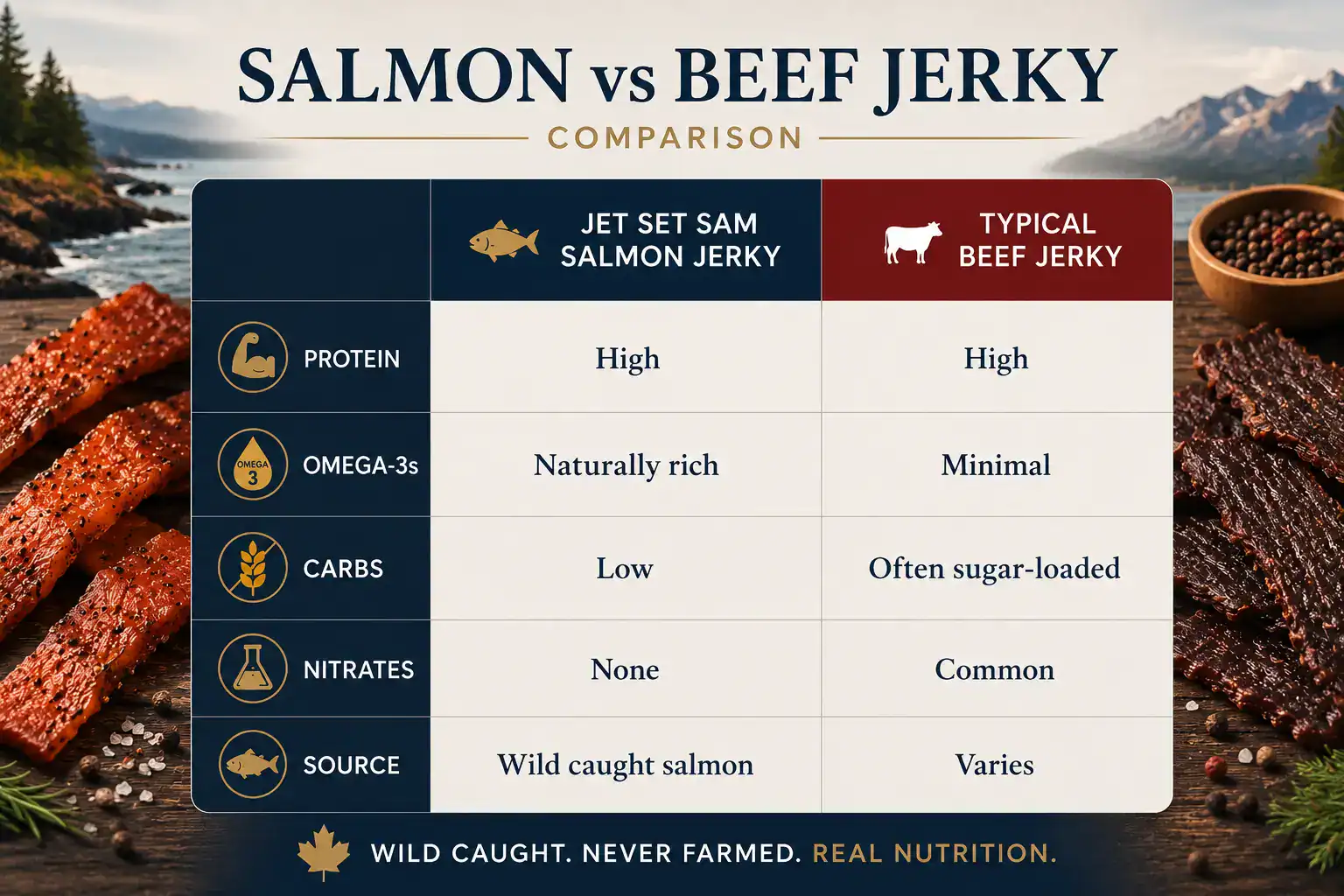
Salmon Jerky vs. Beef Jerky: Which One Actually Wins?
We put both snacks head-to-head on nutrition, health risk, environmental impact, taste, and price — backed by real data, not marketing claims. The results might surprise you.
📋 What's Inside
The Quick Verdict
Beef jerky has owned the road-trip glovebox and gas station counter for generations. But over the past few years, wild salmon jerky has quietly become one of the fastest-growing categories in the entire jerky aisle — and once you look at the actual data on nutrition, long-term health risk, and environmental impact, it's easy to see why.
We're not here to trash beef jerky — it has real strengths, and we'll give it full credit where it's earned. But across the seven categories we tested below, wild salmon jerky comes out ahead in five of them, and the reasons are backed by peer-reviewed research and World Health Organization data, not just taste-test opinions.
🎯 Bottom Line Upfront
If you're choosing jerky purely on nostalgia or a specific savory-beefy craving, beef jerky is still a fine snack in moderation. But if you're choosing based on nutrition, long-term health data, or environmental impact — three areas where the science is genuinely clear — wild salmon jerky is the better pick, and it's not close in a couple of these categories.
Round 1: Nutrition Facts
Ounce for ounce, both proteins deliver serious grams of protein — that part of jerky's reputation is earned by both. But the fat profile, micronutrient content, and macro balance tell a very different story once you look past the protein number on the label.
| Metric (per ~2 oz serving) | 🐟 Salmon Jerky | 🥩 Beef Jerky |
|---|---|---|
| Calories | ~130 kcal | ~110–170 kcal |
| Protein | ~21g | ~20–24g |
| Total Fat | ~2g, mostly unsaturated | ~3–7g, largely saturated |
| Omega-3 (EPA+DHA) | ~200–450mg | ~0mg |
| Vitamin D | Significant source | Negligible |
| Iron & Zinc | Present | Richer source |
| Sodium | ~180–600mg (varies by brand) | ~400–600mg (varies by brand) |
💡 Why Omega-3s Matter Here
Omega-3 fatty acids (specifically EPA and DHA) are essential fats your body cannot produce on its own — they have to come from diet. They're linked to reduced inflammation, better cardiovascular health, and improved brain function. Beef, as a land mammal, contains essentially none of them. This is the single clearest nutritional differentiator between the two snacks.
Round 2: Long-Term Health Risk
In 2015, the World Health Organization's International Agency for Research on Cancer (IARC) classified processed meat as a Group 1 carcinogen — the same hazard category as tobacco smoke and asbestos. Beef jerky is explicitly named in that classification, alongside bacon, sausages, hot dogs, and deli meats.
⚠️ Important Context — Read This Before You Panic
This classification is about the strength of evidence, not the size of the risk. Group 1 means scientists are highly confident processed meat can contribute to cancer risk — it does not mean eating beef jerky is as dangerous as smoking. The IARC review found that eating 50g of processed meat daily was associated with an 18% relative increase in colorectal cancer risk, moving average lifetime risk from roughly 5% to about 5.9%. That's a real, measurable effect — but it's a modest one at typical consumption levels, not an equivalence to tobacco's risk magnitude.
Here's the part that matters most for this comparison: fish is not included in that Group 1 classification. The IARC review specifically covers red and processed mammalian meat — beef, pork, lamb, and their cured/smoked derivatives like jerky. Smoked and cured fish products, including salmon jerky, fall outside that specific classification entirely.
Round 3: Environmental Impact
Cattle farming is one of the most carbon-intensive forms of food production on the planet — largely due to methane from cattle digestion (enteric fermentation), the land required for grazing and feed crops, and the sheer inefficiency of converting feed into edible meat.
| Environmental Factor | 🐟 Wild Salmon | 🥩 Beef |
|---|---|---|
| CO₂e per kg of product | ~3.4 kg | ~18–26 kg |
| Feed required per kg of meat | ~1.3 kg | ~25 kg |
| Edible yield per animal | ~60% | ~30–40% |
| Methane emissions | Negligible | Major contributor |
| Land use required | Minimal (open ocean) | Extensive grazing/feed land |
🌊 Why Wild-Caught Specifically Matters
Wild fish feed and grow entirely on their own in the ocean — there's no cropland, no feed production, no methane-producing digestion process to account for. Commercial fishing emissions come almost entirely from boat fuel, which is why wild-caught salmon's footprint is dramatically lower than land-based livestock, and even modestly lower than many farmed fish species that require manufactured feed.
Round 4: Taste & Texture
This is the fairest round to call a near-tie, and we're not going to pretend otherwise. Beef jerky's tough, fibrous chew is exactly what generations of jerky lovers grew up wanting — that dense, jaw-working bite is part of the appeal, not a flaw.
Salmon jerky is a genuinely different eating experience: because salmon retains natural oils even through the drying process, it comes out flakier and more tender rather than tough — closer to a smoky, chewy-but-yielding bite than beef's dense fibrous texture. Whether that's a pro or a con is almost entirely down to what you're in the mood for.
Round 5: Price & Availability
This is beef jerky's clearest win, and it's worth being upfront about it. Beef jerky is manufactured at massive scale by household brands, sold in literally every gas station, grocery store, and vending machine in North America, and generally priced lower per ounce than premium wild salmon jerky.
Wild salmon jerky is a smaller, more specialized category — often made in smaller batches from wild-caught (rather than farmed) fish, which costs more to source. You'll typically find it at specialty retailers, outdoor stores, or online rather than every corner store.
The Final Scoreboard
🥊 Salmon Jerky vs. Beef Jerky
Full Pros & Cons
🐟 Wild Salmon Jerky
- Rich in omega-3 EPA/DHA — genuinely absent in beef
- Lower in saturated fat
- Significant source of Vitamin D and B12
- Falls outside the WHO's processed-meat cancer classification
- Roughly 6x lower carbon footprint than beef
- Tender, flaky texture from natural oils
- Generally higher price per ounce
- Less widely available in mainstream retail
- Lower in iron and zinc than beef
- Milder, less traditionally "jerky" chew for some palates
🥩 Beef Jerky
- Widely available at nearly any retailer
- Generally lower cost per serving
- Richer source of iron and zinc
- Classic, dense, fibrous chew many grew up on
- Enormous flavor variety across mainstream brands
- Classified under the WHO's Group 1 processed-meat category
- No meaningful omega-3 content
- Higher in saturated fat
- ~6x higher carbon footprint per kg than wild-caught seafood
- Sodium levels comparable to or higher than salmon jerky
Frequently Asked Questions
Ready to Try Wild Salmon Jerky for Yourself?
Now that you've seen the data, taste the difference. Our wild-caught salmon jerky is made the traditional way — no farmed fish, no shortcuts.
Shop Wild Salmon Jerky →