
Craft & History · Pacific Northwest
The Artisanal Tradition of Candied Smoked Salmon: The History, Craft, and Story Behind Indian Candy
Ancient preservation, coastal geography, and a slow, deliberate craft — why great salmon candy is never just salmon coated in sugar.
There's a moment, about six hours into smoking a batch of candied salmon, when the whole room starts to smell like it. Not just smoke — something richer, somewhere between maple and campfire and the sea. The fish has gone from raw and translucent to a deep mahogany, glossy at the edges where the glaze has started to set. This isn't smoked salmon with sugar sprinkled on top. It's a different food entirely, built through a slow, deliberate process that dates back long before anyone owned a smoker with a temperature dial.
Candied smoked salmon — often called Indian Candy in British Columbia, Washington, Alaska, and across the Pacific Northwest — is one of the region's most distinctive foods: sweet, smoky, salty, and deeply savory all at once, with a chewy-tender texture that sits somewhere between smoked salmon and jerky. It's also a food with real history behind it, rooted in Indigenous preservation traditions that predate refrigeration by thousands of years. This is the story of where that craft came from, what actually happens to the fish during the process, and why the best candied salmon is a product of patience and skill rather than a quick sugar coating.
What Is Candied Smoked Salmon?
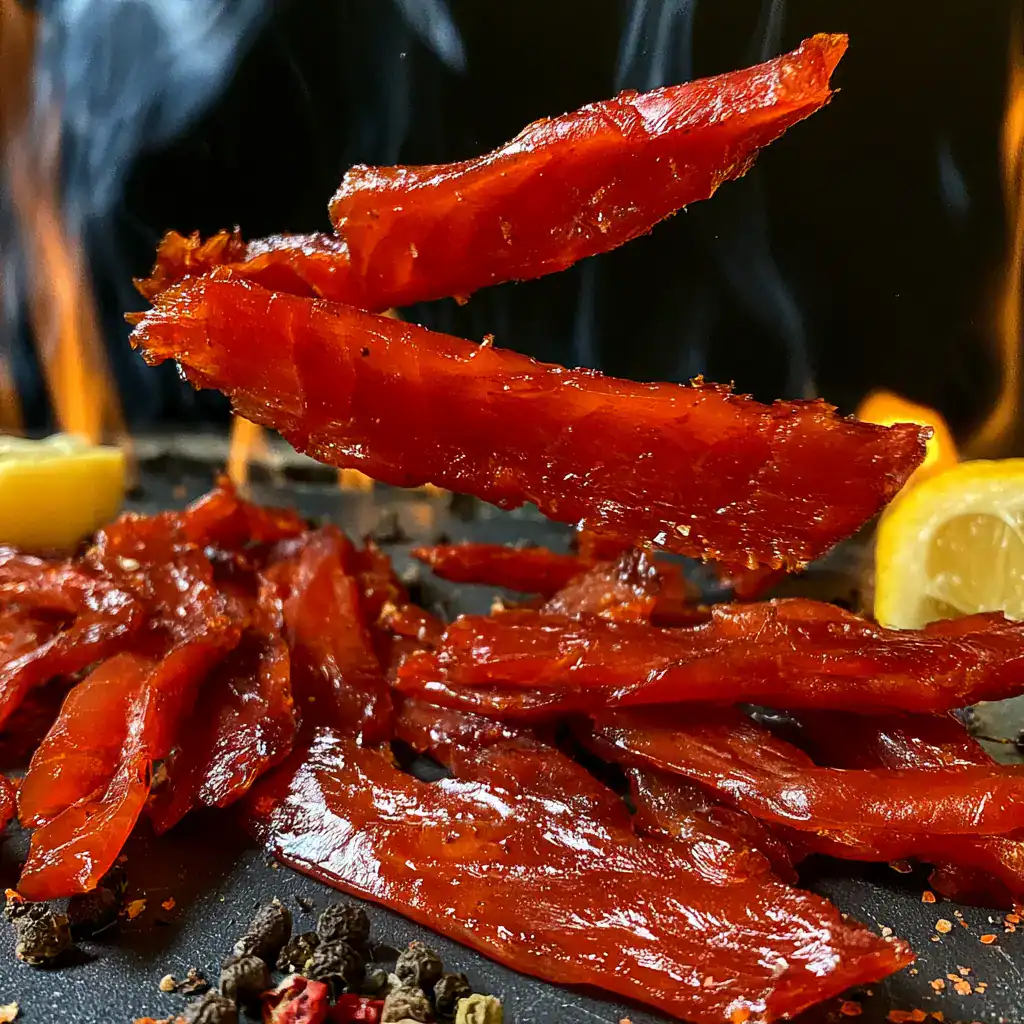
Candied smoked salmon is salmon that has been cured in a salt-and-sugar (or salt-and-maple/honey) mixture, then slowly smoked at low temperature until the exterior turns dark, glossy, and slightly caramelized while the interior stays moist and tender. Unlike regular smoked salmon, it's sweeter, chewier, and smoked longer, giving it a jerky-like texture with a candy-like glaze.
It's a distinct category from ordinary smoked salmon in three ways: the cure includes a meaningful amount of sugar or natural sweetener (not just salt), the smoking time is much longer, and the final texture is firmer and chewier — built to be eaten as a snack rather than sliced thin for a bagel. The result is a piece of fish that behaves a little like candy: it's dense, a little sticky at the edges, and meant to be savored slowly.
Cold-Smoked vs. Hot-Smoked vs. Candied Salmon vs. Salmon Jerky
These four products get confused constantly, and understanding the differences makes it much easier to know what you're buying — or making.
| Product | Cure | Smoking temp | Texture | Typically eaten as |
|---|---|---|---|---|
| Cold-smoked salmon (lox-style) | Salt cure, sometimes sugar | Below ~90°F (32°C) — not cooked by heat | Silky, soft, almost raw | Thin slices, bagels, appetizers |
| Hot-smoked salmon | Salt/brine cure | 150–225°F (65–107°C) — fully cooked | Flaky, moist, tender | Flaked into salads, on its own, in dips |
| Candied smoked salmon (Indian Candy) | Salt + sugar/maple/honey cure | Low and slow, often starting cool and rising, over many hours | Chewy, dense, glossy, caramelized exterior | Snacking, charcuterie, gifting |
| Salmon jerky | Salt cure, often savory seasoning, less sugar | Low heat or dehydration | Dry, firm, less glossy | Portable snack, similar to beef jerky |
The short version: cold-smoked salmon is essentially cured, not cooked by heat. Hot-smoked salmon is fully cooked but stays moist and flaky. Salmon jerky is dried down hard, more like traditional meat jerky, usually with little or no sugar. Candied salmon sits in its own category — smoked long enough to develop a firm, chewy bite, but sweetened and glazed enough to develop that signature glossy, caramelized surface.
Is Salmon Candy Cooked?
Yes. Commercially produced candied smoked salmon is fully cooked during the smoking process, which uses heat over an extended period to both flavor and safely process the fish.
Is Candied Salmon Sweet?
Yes, but it should be balanced. Well-made candied salmon carries a noticeable sweetness from maple syrup, brown sugar, or honey, but that sweetness should sit alongside — not overpower — the natural richness of the salmon, a clean smokiness, and a background note of salt.
What Does Candied Salmon Taste Like?
Sweet, smoky, salty, and savory, with a texture that starts firm and gives way to a tender, almost sticky chew. Good candied salmon tastes distinctly of salmon first — the sweetness and smoke should support the fish, not mask it.
A Note on the Name "Indian Candy"
Before going further into the craft itself, it's worth pausing on the name, because it carries real history and real complexity.
"Indian Candy" is a long-standing colloquial name for candied smoked salmon, used widely by fishing families, small producers, and gift shops across British Columbia, Washington, and Alaska for generations. It is a common-use name, not a formal or standardized term, and its exact origin isn't well documented — no single dated source establishes precisely when or by whom the phrase was first used. Some regional food writers have noted that the terminology around this product has shifted over time, and that older, more overtly derogatory names for the same food are no longer used or acceptable. Today, some Indigenous-owned producers embrace and use the name "Indian Candy" as part of their own branding and heritage, while others use alternatives such as "Native Candy," "salmon candy," or simply "candied smoked salmon."
It's important to be precise here: candied smoked salmon as a food — the practice of curing and smoking salmon, sometimes with natural sweeteners, for long-term preservation — is well documented as part of Indigenous food preservation traditions across the Pacific Northwest and Alaska. The specific name "Indian Candy," however, appears to be a later colloquialism that entered common regional usage rather than a term with a clearly documented Indigenous origin. Where sources disagree or the record is thin, it's more honest to say so than to invent a tidy origin story.
Because language around this dish varies by community and producer, this article uses "candied smoked salmon" and "salmon candy" as the primary terms, while acknowledging "Indian Candy" as the name many people search for and encounter in the Pacific Northwest.
The Deep History: Salmon Preservation in the Pacific Northwest
Preservation Before Refrigeration
Long before mechanical refrigeration existed, Indigenous peoples throughout the Pacific Northwest — spanning what is now coastal and interior British Columbia, Washington, Oregon, and Alaska — developed sophisticated, highly effective methods for preserving salmon. This is well documented by anthropologists, food historians, and Indigenous communities themselves: drying and smoking salmon on wooden racks and in smokehouses was a central practice, built around the massive seasonal salmon runs that moved through coastal rivers each year.
Salmon preservation wasn't a minor technique — for many coastal and river communities, it was foundational to survival. A single salmon run might need to sustain a community through an entire winter, so converting a short, intense harvest season into months of stored, portable food was essential. Fish were split, cleaned, and hung to dry in the wind and sun in some coastal regions, while in other areas — particularly in the interior and in Alaska — salmon strips were hung in smokehouses over slow-burning fires, where smoke and gentle heat worked together to draw out moisture over hours or days.
Different peoples and regions developed their own specific techniques, often refined and passed down as closely guarded family or community knowledge. Wood choice varied by what was locally available and by the flavor a community preferred — alder is commonly cited as a traditional smoking wood across much of the coastal Pacific Northwest, while cedar and other hardwoods were also used in various regions. This variation matters: there was no single, universal "traditional method," but rather a family of related techniques adapted to local geography, climate, and available resources.
Preservation, Trade, and Food Security
Preserved salmon served purposes well beyond a single household's winter pantry. Dried and smoked salmon was light enough to carry, stable enough to store, and valuable enough to trade — historical accounts describe extensive trade networks along the Pacific Coast and into interior regions, with preserved salmon moving between communities that didn't have direct access to major salmon runs. This made salmon preservation not just a food-security practice but an economic one, tying coastal and interior communities together.
Where the Modern "Candied" Recipe Fits In
Here's where historical precision matters most: while salmon smoking and drying is unambiguously an ancient, well-documented Indigenous practice, the specific modern recipe most people now recognize as "candied salmon" or "Indian Candy" — a salt-and-sugar or salt-and-maple cure, followed by smoking with a sweet glaze — reflects a blending of older preservation techniques with sweeteners like maple syrup, brown sugar, or honey. Exactly when and how sugar and maple syrup were incorporated into salmon smoking in a way that produced today's familiar "candy" style isn't something that can be pinned to a specific date, individual, or single origin point based on available sources. What can be said accurately is that the technique — salting or curing fish, then smoking it slowly to preserve and flavor it — is ancient and Indigenous in origin, while the specific sweetened, candy-like version familiar today likely developed and evolved over time, incorporating ingredients like refined sugar and maple syrup that became more widely available through trade and settlement.
This is a case where it's more accurate — and more respectful — to describe a general evolution than to claim a precise invention story that the historical record doesn't clearly support.
From Preservation to Delicacy
For most of its history, smoked and dried salmon was food for survival, not indulgence — a way to convert a short, abundant fishing season into a stable food supply for the rest of the year. Its evolution into something people seek out as a treat, gift, or gourmet snack is a more recent development, tracking alongside broader 20th- and 21st-century shifts in how North Americans think about regional, traditional, and "heritage" foods.
Today, candied smoked salmon occupies a very different place on the table than it once did. It shows up as:
- An appetizer at dinner parties and holiday gatherings
- A snack for road trips, hikes, and long days at the office
- A centerpiece on charcuterie and grazing boards
- A pairing with cocktails, beer, and wine
- A gift — boxed, bagged, or vacuum-sealed for shipping across the country
- A specialty item in Pacific Northwest and Canadian gift shops, farmers markets, and airports
- A way for visitors to the region to bring a taste of the coast home with them
The craft hasn't fundamentally changed — the same core techniques of curing, smoking, and glazing still apply — but the context has shifted from necessity to appreciation. That shift is worth respecting rather than glossing over: a food that once meant the difference between a hungry winter and a secure one is now, for most people encountering it today, a specialty treat. Both things can be true, and understanding the first gives real weight to enjoying the second.
The Science Behind Salmon Candy
Making good candied salmon isn't guesswork — it's food chemistry, even if the people who first perfected it centuries ago didn't have that vocabulary for it.
Curing: Salt, Sugar, and Osmosis
When salt and sugar are packed onto raw salmon, they trigger osmosis: water moves out of the fish's cells and toward the higher concentration of salt and sugar on the surface. This does two things at once. First, it draws out excess moisture, which firms up the flesh and lowers the water activity of the fish — a key factor in both flavor concentration and safe preservation, since bacteria need available moisture to grow. Second, the salt and sugar don't just sit on the surface; over the curing period, they penetrate into the flesh, seasoning it from the inside out rather than just coating it.
This is also where sweetness starts to build. A sugar-and-salt cure doesn't just add flavor at the end — it begins shaping the salmon's flavor and texture hours before it ever sees smoke.
The Pellicle: Why Salmon Needs to "Dry" Before Smoking
After curing, a properly prepared piece of salmon is rinsed (when the recipe calls for it) and left to air-dry, uncovered, until its surface develops a thin, slightly tacky, matte layer called a pellicle. This step is easy to skip and easy to underestimate, but it matters enormously: the pellicle gives smoke something to adhere to. Without it, smoke flavor sits on a wet surface and doesn't bond well; with it, the fish develops a much more even, pronounced smoky character as it smokes.
Smoking: Moisture Loss and Flavor Concentration
Smoking works on two fronts simultaneously. The low, steady heat continues to gently cook the fish and evaporate moisture, which concentrates flavor and firms up texture further. At the same time, compounds in the wood smoke — including natural phenols and other antimicrobial compounds — settle onto and into the surface of the fish, contributing both flavor and a preservative effect that has been relied on for this purpose for thousands of years.
The slower and lower the smoke, generally, the more evenly this process happens — which is part of why rushing candied salmon with high heat tends to produce an inferior product: the exterior can dry out or burn before the interior has had time to properly firm up and absorb smoke flavor.
Caramelization and the Maillard Reaction: Not the Same Thing
The dark, glossy, slightly sticky exterior of good candied salmon is often — and inaccurately — attributed entirely to "caramelization." In reality, two distinct chemical processes are usually at work together, and they aren't the same reaction.
Caramelization is what happens when sugars alone are heated to a high enough temperature that they break down and brown, producing the familiar sweet, nutty notes associated with caramel. It doesn't require protein — just sugar and heat.
The Maillard reaction, by contrast, is a reaction between amino acids (from the proteins in the salmon) and reducing sugars, and it's responsible for much of the deep, savory, complex browning flavor in smoked and roasted foods generally. It tends to become active at somewhat lower temperatures than caramelization and produces a different, more savory flavor profile alongside the sweet one.
In candied salmon, both are plausibly happening at once wherever sugar, protein, and enough heat come together at the fish's surface — the glaze caramelizing on its own where sugar concentrates, and the Maillard reaction browning the protein-rich surface of the fish itself. That combination is a large part of why the finished exterior tastes more complex than "burnt sugar": it's sweet, but it's also savory, roasted, and deeply flavorful in a way that pure caramelized sugar alone wouldn't be.
Why the Outside Is Different From the Inside
The exterior of a well-made piece of candied salmon is drier, darker, glossier, and more concentrated in flavor than the interior, which should remain moist and tender. This isn't a flaw — it's the entire point. The surface is where moisture loss, smoke exposure, and browning reactions are most intense; the interior is protected from direct heat and smoke, so it retains more of its natural moisture and delicate texture. A piece of candied salmon that's uniformly dry throughout, with no contrast between exterior and interior, has usually been oversmoked or overdried.
Why Wild Salmon Matters
Not all salmon behaves the same way in a cure and a smoker, and the choice of species has a real effect on the final product.
Wild vs. Farmed
Farmed salmon in North American markets is almost always Atlantic salmon, raised in aquaculture operations, while wild-caught salmon sold in North America is typically one of five Pacific species: Chinook (king), sockeye, coho, pink, or chum. Beyond the question of species, wild and farmed salmon differ in several practical ways relevant to candying:
- Fat content: Wild salmon generally has a leaner, firmer flesh than farmed salmon, though this varies significantly by species — Chinook, for instance, is notably fattier than lean species like chum or pink.
- Color: Wild salmon gets its color naturally from its diet (particularly krill and other crustaceans), producing natural variation and gradients in color. Farmed salmon color is influenced by the fish's feed and tends to look more visually uniform.
- Texture: Wild salmon tends to have a firmer, denser texture, which holds up well through curing and long smoking.
- Seasonal availability: Wild Pacific salmon is tied to natural seasonal runs, which is part of why wild salmon products have traditionally been seasonal, while farmed salmon is available year-round.
None of this makes one option automatically "healthier" in a way this article is positioned to claim — but for candying specifically, the firmer texture and natural fat structure of wild Pacific salmon is well suited to a process that relies on extended curing and low, slow smoking.
The Pacific Species, and How They Candy Differently
| Species | Typical fat content | Flavor | Texture | Notes for candying |
|---|---|---|---|---|
| Chinook (King) | Highest of the Pacific species | Rich, buttery | Silky, tender | Produces an especially rich, luxurious candied salmon; can be more expensive and less widely available |
| Sockeye (Red) | Moderate-high | Bold, distinctly "salmon-y" | Firm, dense | A classic choice for candying; firm texture holds up well through long smoking |
| Coho (Silver) | Moderate | Milder, more delicate | Tender | A gentler flavor profile that lets sweetness and smoke stand out |
| Pink (Humpback) | Lower | Mild, light | Softer, more delicate | Smaller and leaner; can candy well but is less forgiving of oversmoking |
| Chum (Keta/Dog) | Lowest | Milder, less oily | Leaner, firmer once cured | Its lower fat content is traditionally well suited to drying and smoking |
No single species is objectively "best" for candied salmon — it depends on the character a producer or home cook is aiming for. A fattier species like Chinook produces a richer, more decadent result, while leaner species like chum have long been favored specifically for smoking and drying because their texture holds up well through extended preservation processes. Sockeye sits in a popular middle ground: firm, flavorful, and reliably available, which is part of why it's one of the most commonly used species for candied salmon today.
Eighteen steps
The Artisanal Process, Step by Step
Good candied salmon is not "salmon plus sugar in a smoker." It's a sequence of deliberate decisions, each of which affects the final product — and small changes at almost any stage can shift the result significantly. The rail below tracks the temperature arc of the craft: cold fish, a warming cure, the long climb into smoke and caramelization, then back down to cool.
- 01
Selecting high-quality wild salmon
The process starts with sourcing — freshness, fat content, and species all shape what the finished product will taste and feel like.
- 02
Preparing and trimming the fish
Skin, pin bones, and any bloodline are addressed before the fish goes anywhere near a cure.
- 03
Cutting the salmon into appropriate pieces
Strips or portions are cut with attention to thickness and grain, since uneven pieces cure and smoke unevenly.
- 04
Preparing the cure
A mixture of salt, sugar (often brown sugar, maple sugar, or a similar sweetener), and sometimes other flavorings is measured and mixed with real precision — proportions matter.
- 05
Applying the cure
The cure is packed evenly onto the fish, covering all surfaces.
- 06
Allowing the salmon to cure
The fish rests, refrigerated, for a set period — long enough for osmosis to do its work, drawing out moisture and driving in flavor.
- 07
Rinsing and preparing the fish for smoking
Excess cure is rinsed away where the process calls for it, and the fish is patted dry.
- 08
Developing the pellicle
The fish air-dries, uncovered and refrigerated, until a thin, tacky surface forms — the foundation for good smoke adhesion.
- 09
Loading the smoker
Pieces are arranged with space between them so smoke and heat can circulate evenly around every piece.
- 10
Choosing and controlling the smoking temperature
Low and slow is the general rule — high heat cooks the outside too fast, before the interior and smoke flavor have caught up.
- 11
Selecting appropriate wood
Different woods — alder, maple, and others — impart distinctly different flavor characters, and the choice shapes the final profile as much as the cure does.
- 12
Gradually smoking the salmon
This stage often runs for many hours, sometimes with the temperature raised gradually as the process goes on.
- 13
Applying additional glaze or sweetener
Many producers brush on additional maple syrup, honey, or glaze partway through smoking, building layers of sweetness and shine rather than relying on the initial cure alone.
- 14
Developing the characteristic caramelized exterior
As sugars and proteins on the surface are exposed to heat over time, the deep mahogany, glossy crust forms — the visual signature of good candied salmon.
- 15
Monitoring moisture and texture
An experienced producer is checking, by feel and appearance, for the right balance — firm enough to hold together and chew, moist enough not to be dry or brittle.
- 16
Cooling
The finished salmon needs to cool properly before packaging, both for texture and for food safety.
- 17
Packaging
How the product is packaged — vacuum-sealed, refrigerated, or shelf-stable — depends entirely on the specific commercial process used and its validated safety parameters.
- 18
Storing and serving
Proper storage preserves texture and flavor; serving it at the right temperature (usually room temperature or lightly chilled) lets the full flavor come through.
Throughout all eighteen steps, an artisan is constantly managing a set of interacting variables: time, temperature, humidity, airflow, smoke density, moisture content, cure balance, sweetness level, and final texture. Push smoking time too far and the salmon turns dry and tough. Under-cure it and the texture stays too soft, without the characteristic chew. Too much sugar in the cure and the smoke and salmon flavor get buried; too little and the "candy" character never develops. This is exactly why experienced producers talk about candied salmon as a craft learned over years, not a fixed recipe that behaves identically every time — the same steps, applied to fish with slightly different fat content or thickness, require adjustment.
Traditional vs. Modern Methods
Traditional smokehouse methods — open racks, wind-drying, wood fires tended by hand — relied entirely on an experienced producer's judgment: reading the color of the fish, the texture under their fingers, the behavior of the smoke, the weather itself. That knowledge, built and passed down over generations, remains the foundation of the craft.
Modern commercial production adds tools traditional methods didn't have: precise temperature and humidity control, consistent airflow, and food-safety systems that can validate exactly what combination of time, temperature, and salt/sugar concentration is required to produce a safe, consistent product batch after batch. This doesn't replace the craft — it supports it. A skilled modern producer still relies on experience and judgment to decide when a batch is ready, how much glaze to apply, and how to adjust for the specific fish in front of them; modern equipment simply gives that judgment a more consistent, controllable environment to work in, and gives commercial producers the ability to validate food safety in ways that traditional open-air smoking could not guarantee at scale.
The best modern producers see these as complementary rather than opposed: traditional technique and flavor sensibility, supported by modern food-safety science.
Food Safety: What "Shelf-Stable" Actually Means
Smoked fish production is a genuine food-safety discipline, not just a flavoring technique, and it's worth being clear about the distinction between different types of finished product:
- Refrigerated smoked salmon (including many candied salmon products) requires continuous refrigeration and has a limited shelf life, even after smoking, because it hasn't undergone processing validated to make it safe at room temperature.
- Shelf-stable, commercially processed products are able to sit at room temperature only because they've gone through a validated commercial process — specific combinations of cure concentration, smoking time and temperature, moisture reduction, and packaging (such as vacuum sealing) that have been tested and confirmed to control bacterial growth, including organisms like Clostridium botulinum, which is a specific concern in smoked and vacuum-packed fish products.
- Frozen products are preserved primarily by temperature, and typically need to be smoked or candied before freezing, not preserved by freezing alone.
Shelf stability isn't simply a matter of smoking fish "long enough" — it depends on a validated combination of curing, smoking, moisture control, and packaging that a home process, however carefully done, generally cannot replicate or guarantee without proper testing and equipment. This is exactly why reputable commercial producers follow food-safety protocols, sourcing standards, and — where applicable — regulatory inspection, and why store-bought candied salmon should always be labeled clearly with proper storage instructions (refrigerated vs. shelf-stable) and a best-by date.
How to Recognize High-Quality Salmon Candy
Whether you're buying candied salmon for the first time or you've had it many times before, a few signs reliably separate excellent product from mediocre product:
- Color: A deep, rich mahogany-to-dark-amber color, with visible glossiness where the glaze has set — not pale, dull, or unevenly colored.
- Aroma: A clean, pleasant wood-smoke smell alongside the sweetness — not an acrid, overly sharp, or chemical smoke smell.
- Balance: Sweetness, saltiness, smoke, and natural salmon flavor should all be present and in balance — no single note should dominate so much that the others disappear.
- Texture: Firm enough to hold its shape and give a satisfying chew, but not dry, brittle, or tough throughout.
- Interior moisture: Even though the exterior should be more concentrated and glossy, the interior shouldn't be bone-dry — there should be a noticeable contrast.
- Clean salmon flavor underneath: The fish itself should still taste like good salmon, not be masked entirely by sugar or smoke.
- Visible craftsmanship: Even pieces, consistent color and glaze, and clean trimming are all signs of careful production.
- Appropriate packaging: Clear labeling of ingredients, storage instructions (refrigerated vs. shelf-stable), and a best-by date.
- A reputable, transparent producer: Look for clarity about the species of salmon used, whether it's wild-caught, and where it's sourced and produced.
Warning signs of a lower-quality product tend to be the inverse of the above: an overly dry, tough texture throughout (a sign of oversmoking or under-curing), an artificial or overly one-note sweetness that doesn't taste like real maple, honey, or brown sugar, a harsh or bitter smoke flavor, or vague labeling that doesn't specify species, sourcing, or proper storage.
How to Eat Candied Salmon: 12 Serving Ideas
Candied smoked salmon is remarkably versatile — here are creative, practical ways to enjoy it:
- On a charcuterie or grazing board, alongside cheese, crackers, nuts, and dried fruit — its sweetness and smoke pair naturally with both.
- Straight from the bag as a high-protein snack for hikes, road trips, or the office.
- Flaked over a bagel with cream cheese, for a sweet-and-savory twist on a classic pairing.
- Crumbled into scrambled eggs or an omelet for a smoky, sweet breakfast upgrade.
- Tossed into a green salad, especially one with citrus, arugula, or goat cheese, where its richness plays against bitter greens.
- Paired with sharp or creamy cheeses — aged cheddar, brie, or a soft goat cheese all complement it well.
- Folded into a grain bowl with rice, quinoa, or farro, alongside pickled vegetables.
- Served alongside beer or wine as an appetizer — its sweet-smoky profile pairs particularly well with pale ales, ciders, and off-dry whites.
- Added to a cocktail garnish for a savory-sweet twist on a classic seafood-and-cocktail pairing.
- Packed for a picnic, since it travels well without refrigeration for short periods (always check the specific product's storage guidance).
- Set out for holiday entertaining, where its striking color and rich flavor make it a natural centerpiece on an appetizer table.
- Given as a gift, boxed or bagged, for someone who appreciates regional, artisanal food — a tradition of its own in the Pacific Northwest and Canadian gift economy.
Common questions
Frequently Asked Questions
What is candied smoked salmon?
Candied smoked salmon is salmon cured in a salt-and-sugar (or salt-and-maple/honey) mixture, then slowly smoked until the exterior turns dark, glossy, and slightly caramelized, while the interior stays moist and tender.
Why is it called Indian Candy?
"Indian Candy" is a long-standing colloquial regional name used across British Columbia, Washington, and Alaska, though its precise origin isn't clearly documented. The underlying preservation technique — curing and smoking salmon — is a well-documented Indigenous tradition; the specific name is a later common-use term, and terminology in this space has evolved over time.
Is Indian Candy actually candy?
No — it's smoked, cured salmon, not a sugar confection. The name reflects its sweet, glossy, candy-like character rather than its actual ingredients.
How is salmon candy made?
Salmon is cured in salt and sugar (or a sweetener like maple syrup or honey), left to develop a dry pellicle, then smoked slowly at low temperature for many hours, often with additional glaze applied partway through, until it develops a firm, chewy texture and a caramelized exterior.
What type of salmon is best for salmon candy?
Wild Pacific species — particularly sockeye, Chinook, and coho — are commonly used, each producing a somewhat different result based on fat content and texture. No single species is objectively "best"; the choice shapes the final flavor and richness.
Is salmon candy cooked?
Yes, commercially produced candied salmon is fully cooked through the smoking process.
Is candied salmon sweet?
Yes, though well-made candied salmon balances sweetness with smokiness, saltiness, and the natural flavor of the fish rather than tasting purely sugary.
What wood is traditionally used to smoke salmon?
Alder is widely cited as a traditional smoking wood across much of the Pacific Northwest coast, though maple, cedar, and other hardwoods have also been used depending on the region and available resources.
How long does smoked salmon last?
This depends entirely on the specific product and processing method. Refrigerated smoked or candied salmon typically has a limited shelf life and must stay refrigerated; shelf-stable products rely on validated commercial processing to remain safe at room temperature. Always follow the storage instructions on the specific product's packaging.
What is the difference between salmon candy and salmon jerky?
Salmon candy is cured with a significant amount of sugar or sweetener and smoked until glossy and chewy, with a pronounced sweetness. Salmon jerky typically uses a more savory cure with little or no sugar and is dried until firmer and drier, closer to traditional meat jerky.
How do you eat candied salmon?
It can be eaten on its own as a snack, added to charcuterie boards, flaked over bagels or salads, folded into eggs or grain bowls, or paired with cheese, crackers, beer, or wine.
Can candied salmon be frozen?
Many candied salmon products can be frozen to extend shelf life, but this depends on the specific product and its packaging — always check the manufacturer's storage guidance, since freezing recommendations vary between refrigerated and shelf-stable products.
A living tradition
Craft, Time, and a Tradition Older Than Any Company
Candied smoked salmon carries a genuine story: a preservation technique refined over thousands of years by Indigenous peoples of the Pacific Northwest, shaped by geography, seasonal salmon runs, and hard-won knowledge passed between generations — later evolving, through the addition of sugar and maple syrup, into the sweet, smoky delicacy widely enjoyed today. Understanding that history changes how the finished product tastes, in the best way: not just as a snack, but as something with real craft and real time behind it.
At Jet Set Sam, our Wild Canadian Candied Smoked Salmon is made from wild-caught Pacific salmon, cured and slow-smoked using the same fundamental techniques described here — patience, careful attention to cure and smoke, and respect for a tradition much older than our company.
Explore our smoked salmonA note on sources. Historical claims in this article reflect commonly documented context about Indigenous salmon preservation traditions in the Pacific Northwest. Where the specific origin of the "Indian Candy" name or the exact development of the modern sweetened recipe could not be verified to a specific date, individual, or single source, we say so explicitly rather than asserting a definitive origin.