
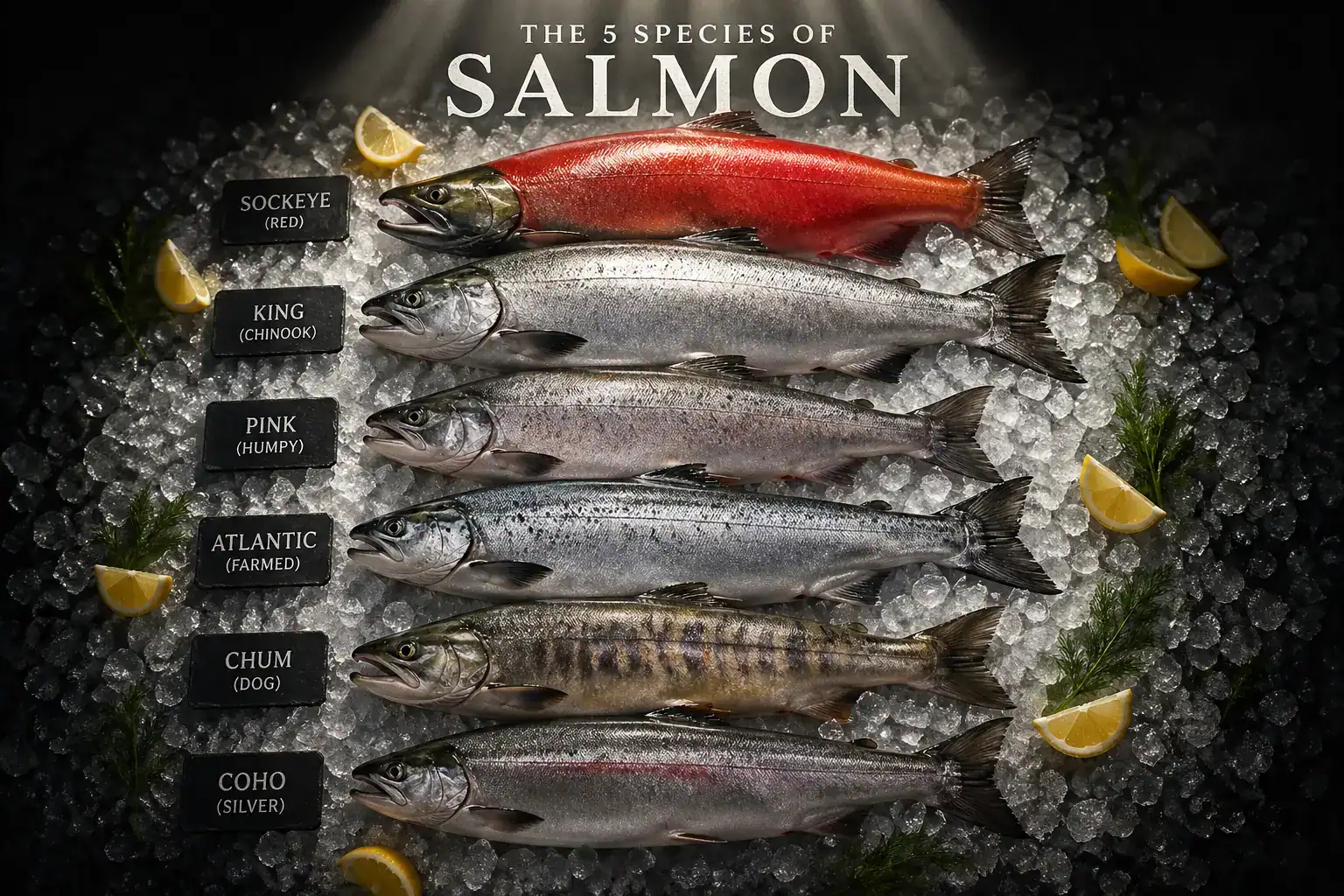
There is no such thing as just “salmon.” There are six distinct species sold commercially — each with a different fat profile, a different flavour character, a different set of strengths in the kitchen, and a different conservation story. Getting them confused is an expensive mistake that leads to disappointing meals. This guide ends the confusion for good.
Whether you’re choosing between fillets at the fishmonger, deciding which species to smoke, building a charcuterie board, or simply trying to understand why the pink stuff in your supermarket canned salmon tastes nothing like what you had at that restaurant in Vancouver — this is the reference you need. We’ve drawn on peer-reviewed nutritional research, NOAA fisheries data, and fifty years of hands-on experience smoking wild Canadian salmon to give you the most complete, accurate, and genuinely useful species comparison available.
Table of Contents
- All Six Species at a Glance
- King (Chinook) Salmon
- Sockeye (Red) Salmon
- Coho (Silver) Salmon
- Pink (Humpback) Salmon
- Chum (Keta) Salmon
- Atlantic Salmon
- Which Species for Which Cooking Method?
- The Definitive Salmon Smoking Hierarchy
- Nutritional Deep-Dive
- Sustainability Ratings
- Frequently Asked Questions
All Six Species at a Glance
Before going deep on each species, here is the complete side-by-side overview across the dimensions that matter most for shoppers and cooks.
| Species | Flavour | Fat Content | Omega-3 EPA+DHA (per 100g) | Protein (per 100g) | Sustainability | Price Point |
|---|---|---|---|---|---|---|
| King (Chinook) | Buttery, rich, complex | Highest | ~2.2g | ~20g | Good | Premium |
| Sockeye (Red) | Bold, robust, savoury-sweet | High | ~1.6g | ~25g | Excellent | Mid-High |
| Coho (Silver) | Mild-medium, clean finish | Medium | ~0.9g | ~22g | Good | Mid |
| Pink (Humpback) | Mild, light, delicate | Low | ~0.6g | ~22g | Excellent | Budget |
| Chum (Keta) | Mild, clean, subtle | Low-Med | ~0.7g | ~25g | Excellent | Mid-Low |
| Atlantic | Mild, creamy, consistent | Very High | ~2.1–3.8g | ~25g | Variable | Mid |
Research Note: Nutritional values shown are approximate per 100g cooked weight and vary by season, diet, geography, and preparation method. Data sourced from USDA FoodData Central, NOAA, and a 2023 peer-reviewed comparative study published in Aquaculture Research (Gillies et al.).
1. King (Chinook) Salmon
Also known as: Chinook · Scientific name: Oncorhynchus tshawytscha
Quick Stats
- Omega-3 EPA+DHA: ~2.2g per 100g
- Protein: ~20g per 100g
- Fat Content: Highest of all wild Pacific species
- Average Adult Weight: 20–50 lbs (up to 100 lbs)
King salmon is the monarch of the Pacific — the largest, the fattest, the most prized, and without question the most expensive species commercially available. The flesh ranges from ivory to deep red-orange depending on diet, and the fat is distributed in thick, visible white striations throughout the fillet — those fat seams are the visual signature of a fish that has spent years accumulating energy reserves for its long upstream spawning migration.
In terms of flavour, King salmon occupies its own tier. The extraordinary fat content delivers a richness that borders on unctuous — the fish almost melts on the palate. It has a complex, layered flavour profile: sweet from the fat, savoury from the muscle, with a clean ocean finish that dissipates without any lingering fishiness. Chefs who work regularly with multiple salmon species consistently describe King as the one that needs the least help in the kitchen.
✅ Strengths
- Unrivalled richness and depth of flavour
- Highest fat content of any wild Pacific species — stays moist under almost any cooking method
- Superior cold-smoking candidate — fat carries smoke beautifully
- Excellent source of omega-3 EPA+DHA (~2.2g per 100g)
- Holds structural integrity at high heat — ideal for grilling
- The rare White King variant (lacking red pigment) is considered a delicacy
❌ Limitations
- Significantly more expensive than all other species
- Some populations listed as threatened or endangered under the ESA
- Lower protein density than leaner species due to fat volume
- High caloric density not suited to lower-calorie dietary plans
- Limited availability outside specialist fishmongers
🍽 Best Used For
Hot smoking · Cold smoking (lox) · Grilling · Special occasion dinners · Sashimi & crudo · Butter poaching · Premium gifting
Kitchen Tip: King’s fat content makes it extraordinarily forgiving — it’s the species least likely to dry out if slightly overcooked. Season minimally (good salt, citrus, fresh herbs), cook to 125–130°F internal for a silky, translucent centre, and let the fish do the work.
2. Sockeye (Red) Salmon
Also known as: Red Salmon · Blueback · Scientific name: Oncorhynchus nerka
Quick Stats
- Omega-3 EPA+DHA: ~1.6g per 100g
- Protein: ~25g per 100g
- Fat Content: High
- Average Adult Weight: 5–15 lbs
If King salmon is about luxury, Sockeye is about character. This is the species with opinions — bold, assertive, deeply pigmented, and entirely uninterested in blending into the background. The flesh colour is genuinely startling the first time you encounter it: a vivid, almost arterial crimson that is entirely natural, derived from the astaxanthin in the zooplankton and krill that dominate the sockeye’s diet. That colour does not fade significantly with cooking, making a properly prepared sockeye fillet one of the most visually dramatic foods on a plate.
The flavour matches the colour in intensity — robust, rich, with a savoury depth and a sweet finish that holds up beautifully against assertive flavours: strong glazes, wood smoke, high heat, bold spices. It’s the species that Pacific Northwest smokehouses have built their reputations on, and the one most commonly used for traditional Indigenous salmon preparations. For salmon candy and smoked nuggets, Sockeye is the default choice — its fat content keeps it moist through the long smoke while its flavour intensifies rather than diminishes under heat and glaze.
✅ Strengths
- Outstanding hot-smoking species — fat and flavour both intensify under smoke
- Highest protein of the popular wild species (~25g per 100g)
- Extraordinary astaxanthin content — the most potent natural antioxidant in salmon
- Deep crimson colour is visually spectacular and entirely natural
- More accessible price point than King while delivering premium quality
- Firm texture holds well through vigorous, high-heat cooking methods
❌ Limitations
- Bold, assertive flavour is not universally appealing — can be too intense for sensitive palates
- Firmer texture can feel dry if overcooked beyond 145°F
- Some BC and Pacific Northwest populations face conservation pressure
- Less fat than King — requires slightly more attention to avoid dryness in extended cooks
🍽 Best Used For
Hot smoking · Salmon candy · Salmon jerky · Grilling · Pan-searing · Charcuterie boards · Cedar plank cooking
3. Coho (Silver) Salmon
Also known as: Silver Salmon · Scientific name: Oncorhynchus kisutch
Quick Stats
- Omega-3 EPA+DHA: ~0.9g per 100g
- Protein: ~22g per 100g
- Fat Content: Medium
- Average Adult Weight: 8–12 lbs
Coho sits comfortably in the middle of the salmon spectrum — not as opulent as King, not as intense as Sockeye, but a genuinely excellent and versatile fish that rewards skilled cooking with a clean, well-balanced result. The flesh is a reddish-orange that is paler than Sockeye but more vivid than Pink or Chum, and the texture is notably softer than other Pacific species — supple and yielding rather than firm and meaty.
Flavour-wise, Coho occupies an appealing middle ground: more character than Pink, more approachability than Sockeye. It has a clean, mild-to-medium salmon flavour with a slightly sweet finish and none of the assertive richness that can polarise people about bolder species. For households where one member finds strong salmon flavour off-putting, Coho is frequently the gateway species that converts them. It pairs beautifully with delicate preparations — citrus, fresh herbs, light glazes — that would be overwhelmed by Sockeye’s force.
✅ Strengths
- Highly versatile — adapts to a wider range of cooking methods than any other species
- Approachable, crowd-pleasing flavour profile that suits mixed-preference households
- Excellent for first-time salmon eaters or those sensitive to strong fish flavour
- Good source of B12, selenium, niacin, and omega-3 fatty acids
- Widely available across North America at accessible mid-range prices
- Alaska wild Coho is sustainably managed and well-regulated
❌ Limitations
- Softer texture can break apart on the grill or under rough handling
- Lower omega-3 content than King or Sockeye
- Some Pacific Northwest populations are listed as threatened under the ESA
- Farmed Coho is increasingly available but varies widely in quality
- Mild flavour disappears entirely under heavy glazes or aggressive seasoning
🍽 Best Used For
Baking · Light smoking · Ceviche & crudo · Sheet pan dinners · Fish tacos · Beginner-friendly preparations · Poaching
4. Pink (Humpback) Salmon
Also known as: Humpback Salmon · Humpy · Scientific name: Oncorhynchus gorbuscha
Quick Stats
- Omega-3 EPA+DHA: ~0.6g per 100g
- Protein: ~22g per 100g
- Fat Content: Low
- Average Adult Weight: 3–5 lbs
Pink salmon is the workhorse of the Pacific fishery — the most abundant wild salmon species on earth, returning in such extraordinary numbers that Alaska’s rivers can become visibly crowded during peak runs. Its name comes not from the fish’s silver-pink ocean colouring but from the pale pinkish flesh of the fillet, a lighter tone reflecting lower carotenoid intake compared to the krill-rich diet of Sockeye. Spawning males develop a pronounced shoulder hump — earning the “humpback” nickname — and the fish has a short, strict two-year life cycle that makes its population highly predictable.
As a food fish, Pink salmon is frequently underestimated. Its low fat content gives it a mild, very delicate flavour that works beautifully as a blank canvas — it takes on the character of whatever you pair it with rather than asserting its own. The vast majority of canned salmon is Pink for this very reason: it is accessible, affordable, sustainably abundant, and palatable to people who don’t consider themselves salmon lovers. Properly smoked or well-seasoned, Pink salmon reveals genuine quality that its modest price would not suggest.
✅ Strengths
- Most affordable of all wild Pacific species
- Highly sustainable — among the most abundant fish in the Pacific Ocean
- Lower calorie count due to reduced fat — well suited to calorie-conscious diets
- Rich in selenium, B12, and niacin despite lower overall fat content
- Ideal blank-canvas flavour for strongly seasoned preparations
- Widely available canned year-round at every price point
❌ Limitations
- Lowest fat content produces less succulent results when grilled or baked without added fat
- Lowest omega-3 EPA+DHA of all Pacific species (~0.6g per 100g)
- Flesh softens quickly — a poor candidate for high-heat searing or open-flame grilling
- Delicate flavour too subtle to hold up against bold glazes or aggressive seasoning
- Quality deteriorates faster post-catch than fattier species — freshness is critical
🍽 Best Used For
Canned salmon products · Salmon patties & fish cakes · Retort pouches · Poaching · Budget meal prep · Smoked salmon spreads & dips
5. Chum (Keta) Salmon
Also known as: Keta Salmon · Dog Salmon · Silverbrite · Scientific name: Oncorhynchus keta
Quick Stats
- Omega-3 EPA+DHA: ~0.7g per 100g
- Protein: ~25g per 100g
- Fat Content: Low-Medium
- Average Adult Weight: 8–15 lbs
Chum salmon has an image problem it does not fully deserve. The common name “dog salmon” — which refers to the canine-like teeth males develop during spawning — and its historic use as sled dog food in Alaska have given it an unfair reputation as the bottom of the Pacific salmon hierarchy. The seafood industry even rebranded it “keta salmon” in the 1990s to distance it from these associations. The reality is more interesting: properly handled, ocean-bright Chum is a genuinely good food fish that is criminally underappreciated.
The critical qualifier is “properly handled.” Chum deteriorates faster after death than most other species, and the quality difference between well-iced, ocean-bright Chum and a poorly handled specimen is dramatic. At its best — caught fresh, immediately iced, and cooked or smoked within days — Chum has a clean, mildly sweet flavour with a firm, lean texture that works particularly well in smoking, stews, and preparations where a neutral base quality is an asset rather than a limitation.
✅ Strengths
- Tied with Sockeye for the highest protein content (~25g per 100g)
- One of the most sustainably abundant wild Pacific salmon species
- Lean profile ideally suits lower-fat and high-protein dietary plans
- Underpriced relative to its quality when properly and freshly handled
- Excellent for large-batch smoking — mild flavour absorbs wood smoke cleanly
- Highly prized roe (ikura) is a premium, sought-after seafood product
❌ Limitations
- Quality is highly variable — deteriorates faster than most species post-catch
- Negative name recognition creates a persistent, unfair marketplace disadvantage
- Lower omega-3 content than fattier species
- Pale flesh colour is less visually appealing than Sockeye or King
- Less frequently found fresh at retail — most often available only as canned or smoked
🍽 Best Used For
Large-batch hot smoking · Fish stews & chowders · High-protein meal prep · Canned products · Value-driven entertaining
6. Atlantic Salmon
Also known as: Salmo salar · The farmed standard
Quick Stats
- Omega-3 EPA+DHA: ~2.1–3.8g per 100g (farmed, feed-dependent)
- Protein: ~25g per 100g
- Fat Content: Very High
- Average Farmed Weight: 8–12 lbs
Here is the elephant in the room: wild Atlantic salmon are critically endangered. Commercial fishing of wild Atlantic salmon is entirely prohibited in the United States and Canada, and severely restricted or banned across Europe. The Atlantic salmon you find at the supermarket — every single time — is farmed. Understanding this is not a minor footnote; it fundamentally changes the conversation about nutrition, sustainability, quality, and value.
Farmed Atlantic salmon is the world’s most widely consumed salmon species by an enormous margin, and it became so for legitimate reasons: it grows quickly in aquaculture conditions, produces consistently large, thick fillets with high fat content, and delivers a mild, creamy flavour that is broadly appealing. The omega-3 content can actually exceed that of wild species — though the omega-3-to-omega-6 ratio is generally less favourable. A 2023 peer-reviewed Canadian study published in Aquaculture Research found that the greatest nutritional differences were between species rather than wild versus farmed, and that well-managed farmed Atlantic salmon remained nutritionally impressive.
✅ Strengths
- Highest total omega-3 content of any commercially available salmon (2.1–3.8g per 100g)
- Extremely consistent in size, colour, and flavour — reliable and predictable for meal planning
- Most widely available salmon globally — found in virtually every supermarket worldwide
- High fat content makes it very forgiving to cook — difficult to dry out
- Generally the lowest price per kilogram for a high-omega-3 protein source
- Well-regulated producers (Norway, Scotland) maintain strong welfare and quality standards
❌ Limitations
- Almost universally farmed — wild Atlantic salmon is commercially extinct
- Sustainability rating varies dramatically by farm, operator, and country of origin
- Less favourable omega-3-to-omega-6 ratio than wild Pacific species
- Flesh colour achieved through added carotenoid pigments (canthaxanthin or astaxanthin), not natural diet
- Antibiotic use in some operations — quality of regulation varies internationally
- Flavour is milder and less complex than wild Pacific species
🍽 Best Used For
Everyday weeknight cooking · Baking & roasting · Cold smoking (lox) · Sushi (farmed) · Budget omega-3 source · High-volume restaurant cooking
Buying Tip: Look for ASC (Aquaculture Stewardship Council) or BAP (Best Aquaculture Practices) certification. Norwegian or Scottish-origin farmed Atlantic salmon is generally produced under stricter regulatory standards than equivalents from some other regions.
Which Species for Which Cooking Method?
Not all salmon species perform equally under all cooking methods. Here’s the definitive guide to matching species with technique:
| Cooking Method | Best Species | Why | Avoid |
|---|---|---|---|
| Hot Smoking | Sockeye, King | High fat prevents drying over extended low-heat smoke; bold flavour intensifies with wood and glaze | Pink (too lean, dries rapidly) |
| Cold Smoking (Lox) | King, Atlantic | Maximum fat produces silkiest translucent texture; King’s flavour complexity elevates the result | Chum (deteriorates too quickly) |
| Grilling (High Heat) | King, Sockeye | Fat-rich, firm flesh holds structural integrity at high heat without falling apart | Coho, Pink (soft texture breaks apart) |
| Baking / Roasting | Coho, Atlantic, Sockeye | Medium-high fat holds moisture; even heat suits medium-firm texture | None — all species bake adequately |
| Pan-Searing | Sockeye, King | High fat produces superior crust development; flesh stays moist while exterior crisps | Pink (low fat produces chalky, dry sear) |
| Poaching | Coho, Pink, Chum | Gentle heat preserves lean flesh; delicate flavour shines in subtle poaching liquids | King (high fat can cloud poaching liquid) |
| Canning / Pouches | Pink, Chum | High-heat process suits robust structure of lean species; abundance supports commercial volumes | King (too expensive; fat content separates) |
| Sashimi / Crudo | King, Atlantic (farmed) | Fat creates melting, silky raw texture; clean flavour is unobstructed by heat | Chum, Pink (texture too firm or lean when raw) |
| Jerky | Sockeye, Chum | Lower relative fat produces cleaner, shelf-stable jerky; Sockeye flavour survives the drying process intact | King (fat content goes rancid faster in dried format) |
The Definitive Salmon Smoking Hierarchy
“In fifty years of smoking wild Canadian salmon, the verdict has remained consistent: Sockeye for hot smoking, King for cold. Everything else is a respectable substitute — never quite the same.”
Since smoking is central to Pacific Northwest salmon culture, it deserves a dedicated breakdown. Here is how each species ranks as a smoking candidate, and precisely why:
🥇 Tier 1 — The Ideal Smoking Species
Sockeye is the Pacific Northwest smoking tradition incarnate — the species that generations of Indigenous smokehouse operators, commercial smokers, and backyard pitmasters have consistently returned to because nothing else produces the same combination of deep colour, caramelised exterior, rich flavour, and moist interior through the hours-long hot-smoking process. Its fat content is high enough to protect the flesh without being so high that it overwhelms the smoke or creates an overly greasy product. King salmon takes the top position for cold smoking — its extraordinary fat content produces the silkiest, most translucent smoked lox imaginable, with a flavour complexity that cold smoke amplifies rather than masks.
🥈 Tier 2 — Excellent With Proper Technique
Coho hot-smokes beautifully when handled with care — its softer flesh requires lower smoking temperatures and a shorter process, but the result is mild, delicate, and genuinely excellent. Atlantic salmon is an outstanding cold-smoking fish (most commercial lox is Atlantic) and handles hot-smoking well, though its milder flavour produces a less complex result than Sockeye.
🥉 Tier 3 — Workable, Best in Volume
Chum (Keta) is a surprisingly capable smoking salmon when the fish is ocean-bright and properly handled. Its mild flavour absorbs smoke cleanly and its lean flesh firms up well in the smoker. It is the traditional choice for large-batch tribal smoking operations in the Pacific Northwest. Pink salmon can be smoked but requires careful management — its low fat content means it dries quickly, and the result lacks the richness of fattier species. It works best in shorter, lower-temperature smokes with frequent glaze application to compensate for the lean flesh.
Nutritional Deep-Dive: Species by Species
All salmon species are nutritionally impressive in absolute terms — they all provide complete protein, omega-3 EPA and DHA, vitamin B12, selenium, and vitamin D. The differences between species are real but must be understood in context: the least nutritious species of wild salmon still dramatically outperforms most common alternative protein sources.
| Species | Calories (per 100g) | Protein | Total Fat | Omega-3 EPA+DHA | Vitamin D (IU) | Vitamin B12 (mcg) |
|---|---|---|---|---|---|---|
| King (Chinook) | ~231 | ~20g | ~14g | ~2.2g | ~483 | ~3.2 |
| Sockeye | ~216 | ~25g | ~11g | ~1.6g | ~762 | ~5.8 |
| Coho (wild) | ~146 | ~22g | ~6g | ~0.9g | ~430 | ~3.0 |
| Pink | ~153 | ~22g | ~5g | ~0.6g | ~360 | ~3.5 |
| Chum (Keta) | ~154 | ~25g | ~5g | ~0.7g | ~310 | ~3.2 |
| Atlantic (farmed) | ~208 | ~25g | ~13g | ~2.1–3.8g | ~526 | ~3.2 |
Key Nutritional Standouts
Sockeye delivers the most vitamin B12 per serving of any species (~5.8 mcg — nearly 250% of the recommended daily value) and has the highest natural astaxanthin content of all salmon. King salmon leads wild Pacific species in total omega-3 volume. Farmed Atlantic can exceed all wild species in absolute omega-3 quantity depending on feed composition. Chum and Pink offer the best protein-to-calorie ratio for those following lean dietary plans. No species here is a poor nutritional choice — the differences are meaningful but the baseline is exceptional across the board.
Sustainability Ratings: Which Species to Choose?
Sustainability is not a binary — it varies significantly by species, fishery, geography, and season. Here is the practical picture for informed purchasing decisions:
| Species | Overall Rating | Wild Population Status | What to Look For |
|---|---|---|---|
| Pink Salmon | ⭐⭐⭐⭐⭐ Excellent | Abundant — most numerous Pacific salmon species on earth | Wild Alaska Pink; MSC certified |
| Sockeye Salmon | ⭐⭐⭐⭐⭐ Excellent | Strong in Bristol Bay; some BC runs under pressure | Alaska Sockeye; Bristol Bay origin; MSC certified |
| Chum Salmon | ⭐⭐⭐⭐⭐ Excellent | Second most abundant Pacific species; significantly underutilised | Wild Alaska Keta; BC Chum from certified fisheries |
| King Salmon | ⭐⭐⭐⭐ Good – Variable | Some populations ESA-listed; others healthy | Alaska Chinook; avoid California/Columbia River origin |
| Coho Salmon | ⭐⭐⭐⭐ Good – Variable | Alaska stocks healthy; Pacific NW has threatened/endangered runs | Wild Alaska Coho; MSC certified; avoid Oregon/CA origin |
| Atlantic Salmon (farmed) | ⭐⭐⭐ Variable | Wild populations: critically endangered, commercially extinct | ASC or BAP certified; Norwegian or Scottish origin preferred |
Frequently Asked Questions
Which salmon species has the most omega-3s?
King (Chinook) salmon has the highest omega-3 content of any wild Pacific species, delivering approximately 2.2g of combined EPA and DHA per 100g cooked. Farmed Atlantic salmon can actually exceed this, providing 2.1–3.8g per 100g depending on feed composition — making it one of the richest omega-3 whole foods commercially available. Sockeye comes third among wild species at around 1.6g, followed by Coho (~0.9g), Chum (~0.7g), and Pink (~0.6g).
What is the best salmon species for smoking?
Sockeye is the premier hot-smoking species — its high fat content and bold flavour both intensify beautifully under wood smoke and glaze, producing the deep colour and caramelised finish that defines Pacific Northwest smoked salmon. King (Chinook) is the ideal cold-smoking fish, producing the silkiest, most flavour-complex smoked lox of any species. Coho and Atlantic salmon are excellent secondary options for both methods. Chum works well for large-batch smoking. Pink salmon can be smoked but dries out easily due to its low fat content.
What is the mildest tasting salmon?
Pink salmon is the mildest and most delicately flavoured of all six species, with a light, clean taste and low fat content that makes it a blank canvas for other flavours. Chum (Keta) is comparably mild. Coho sits in the comfortable middle ground — more flavour than Pink, more approachability than Sockeye. Farmed Atlantic is mild-to-medium with a creamy, consistent character. Sockeye and King are the most flavourful and assertive species.
Is Atlantic salmon wild caught?
Almost never. Wild Atlantic salmon populations are critically endangered, and commercial fishing is prohibited in the US, Canada, and severely restricted across Europe. Every Atlantic salmon sold commercially — in supermarkets, restaurants, and at fishmongers — is farmed, primarily in Norway, Scotland, Chile, and Canada. If a label simply says “Atlantic salmon” without specifying “wild caught,” it is farmed.
What is the difference between King and Sockeye salmon?
King (Chinook) is the largest Pacific species with the highest fat content and a rich, buttery, almost unctuous flavour. Its flesh ranges from ivory to deep orange depending on diet. Sockeye is smaller and leaner, with a more intense, distinctly savoury-rich flavour and a vivid deep-red flesh colour derived from its krill-heavy ocean diet. King excels in cold smoking, grilling, and sashimi; Sockeye is the superior hot-smoking, salmon candy, and pan-searing species. King commands a higher price; Sockeye offers better value relative to eating quality and is more widely available.
Which salmon species is most sustainable?
Wild Alaska Pink salmon and wild Alaska Sockeye from Bristol Bay are consistently rated among the most sustainable seafood choices available globally, managed under some of the most rigorous fisheries regulations in the world. Wild Chum (Keta) salmon is also highly sustainable and significantly underutilised relative to its population size. Wild King and Coho vary significantly by specific run and geography — Alaska stocks are generally healthy while some Pacific Northwest populations are listed under the Endangered Species Act. Farmed Atlantic sustainability varies widely by producer and origin.
The Bottom Line: There Is No Bad Salmon
Every species covered in this guide — even the underestimated Pink and the maligned Chum — offers genuine nutritional value, real culinary potential, and a connection to one of the world’s most remarkable fish. The “right” choice depends entirely on what you’re making, how you’re cooking it, what your budget allows, and whether you’re prioritising flavour intensity, fat content, omega-3s, or environmental impact.
If you could only choose one species for everyday kitchen use: Sockeye offers the best overall combination of bold flavour, nutritional density, wide availability, reasonable price, and versatility across cooking methods. If budget is no object: King for anything requiring maximum richness. If you’re cooking for mixed preferences or new salmon eaters: Coho as the reliable crowd-pleaser. For everyday value and sustainability: Pink or Chum.
At Jet Set Sam, we’ve spent fifty years working primarily with wild British Columbia Sockeye and Pink salmon — and the more time you spend with wild Pacific fish, the more the differences between species matter. We hope this guide helps you make better, more informed choices every time you reach for a fillet, open a tin, or fire up the smoker.
© 2026 Jet Set Sam Inc. — Vancouver, British Columbia, Canada
Wild Canadian Smoked Salmon crafted since 1975 · jetsetsam.com