
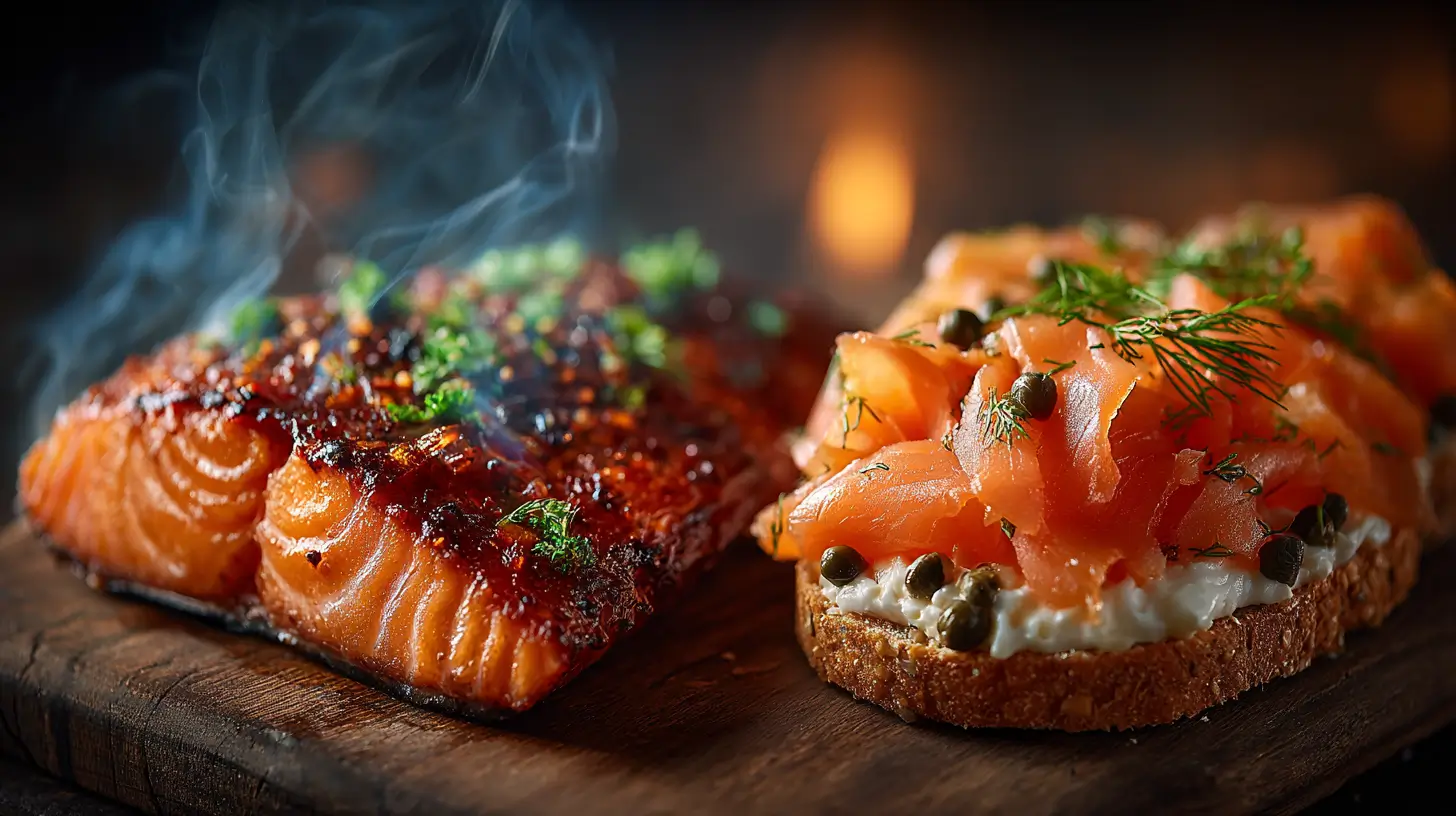
You’ve seen both on menus, at fish markets, and in gourmet food shops. But do you actually know the difference between hot-smoked and cold-smoked salmon — and why it matters for flavor, texture, nutrition, and how you use it? If not, you’re not alone. This guide breaks it all down in plain language so you can make the right choice every time.
The Short Answer
Hot-smoked salmon is cooked during the smoking process at temperatures between 120°F and 180°F (49°C–82°C), producing a fully cooked, flaky, firm fish with a deep, rich, smoky flavor throughout. Cold-smoked salmon is cured but never cooked — smoked at temperatures below 90°F (32°C) — remaining silky, translucent, and delicate with a subtle smoky note.
Same fish. Entirely different results. And each one excels in completely different situations.
How Each Method Works
Hot Smoking: Low, Slow, and Fully Cooked
Hot smoking is the older of the two methods and the one most deeply rooted in Indigenous Pacific Northwest traditions. The salmon is first dry-cured or brined in a salt-and-sugar mixture for several hours, then placed in a smoker where both heat and smoke are applied simultaneously. The combination of heat, smoke, and time does two things at once: it cooks the salmon through and infuses it with deep, layered smoky flavor.
The result is a product that is:
- Fully cooked and food-safe straight from the package
- Flaky and firm in texture, similar to baked salmon
- Intensely smoky with a rich, bold flavor throughout
- Versatile enough to eat as a snack, flake into dishes, or serve as a centerpiece
Hot-smoked salmon is the foundation for beloved Pacific Northwest specialties like candied salmon (also called Indian candy or salmon candy), smoked salmon jerky, and the whole family of smoked salmon nuggets — products where the smoking process is itself the cooking, curing, and flavoring all in one.
Cold Smoking: The Art of Smoke Without Heat
Cold smoking is the more technically precise of the two methods. The salmon is first cured heavily in salt (and sometimes sugar) — a process that draws out moisture, firms the flesh, and makes the fish safe to eat without cooking. The cured salmon is then exposed to cool smoke (below 90°F/32°C) for anywhere from several hours to several days.
Because no significant heat is applied, the salmon:
- Remains completely raw in texture — silky, glossy, and soft
- Develops a delicate, subtle smoky flavor rather than a bold one
- Retains a translucent, jewel-like appearance
- Slices into thin, elegant pieces that melt on the tongue
This is the smoked salmon lox style you find draped over bagels, rolled in sushi, or fanned out on brunch platters. The texture is as much a feature as the flavor — and that silky, melt-in-your-mouth quality is entirely a product of the cold-smoking and curing process.
Hot-Smoked vs Cold-Smoked Salmon: Head-to-Head Comparison
| Hot-Smoked Salmon | Cold-Smoked Salmon (Lox) | |
|---|---|---|
| Temperature | 120°F – 180°F (49–82°C) | Below 90°F (32°C) |
| Is it cooked? | Yes — fully cooked | No — technically raw (but cured) |
| Texture | Flaky, firm, meaty | Silky, smooth, melt-in-your-mouth |
| Smoke flavor | Bold, deep, rich throughout | Subtle, delicate, surface-forward |
| Color | Opaque, deep orange – red | Translucent, bright glossy pink |
| Best uses | Snacking, salads, pasta, charcuterie, jerky | Bagels, brunch, sushi, canapés, boards |
| Shelf life (fresh) | Longer — heat kills more bacteria | Shorter — requires careful refrigeration |
| Safe for vulnerable groups? | Yes — fully cooked | Use caution — technically raw |
How They Taste: An Honest Flavor Guide
Hot-Smoked Salmon Flavor Profile
If you’ve never tried properly made hot-smoked salmon, the flavor intensity can be genuinely surprising — in the best possible way. Because the smoke penetrates the entire fillet during cooking, every bite is deeply, fully smoky. The natural oils in wild salmon carry the smoke flavor beautifully, creating a product that is rich, complex, and satisfying in a way that’s hard to describe until you’ve experienced it.
The curing process before smoking typically uses sugar alongside salt, which caramelizes during the heat and produces a slight sweetness that balances the savory smokiness. This is the flavor foundation behind candied salmon — where that caramelized glaze is pushed much further — and it’s why hot-smoked salmon from Pacific Northwest artisans is so different from anything you’ll find at a grocery store.
Cold-Smoked Salmon (Lox) Flavor Profile
Cold-smoked salmon is a study in subtlety. The smoke flavor is present but restrained — a background note that enhances rather than dominates. What comes forward instead is the clean, fresh taste of the salmon itself: slightly salty from the cure, faintly rich from the natural oils, and with a delicate sweetness that good wild salmon always carries.
This is a product where the quality of the fish matters most. Because the flavoring is so gentle, inferior farmed salmon has nowhere to hide in a cold-smoke. Wild salmon — especially wild sockeye — is transformative in this preparation. Its naturally bold flavor and deep color produce a cold-smoked lox that is in a completely different category from grocery store varieties.
Which One Is Better for You Nutritionally?
The good news: both hot-smoked and cold-smoked salmon are exceptionally nutritious, and the smoking method does not significantly diminish the nutritional profile of wild salmon. Both preparations deliver:
- Omega-3 fatty acids (EPA and DHA) — essential for cardiovascular health, brain function, and reducing inflammation
- High-quality complete protein with all essential amino acids
- Vitamins B12 and D — critical for energy, nerve function, and immunity
- Selenium — a powerful antioxidant mineral found abundantly in wild Pacific salmon
- Potassium for heart and muscle health
A few nuances worth knowing:
- Hot-smoked salmon tends to be slightly higher in sodium due to longer cure times and the cooking process concentrating flavors
- Cold-smoked salmon retains slightly more of the delicate Omega-3s that can be affected by high heat, though the difference is modest
- Candied salmon varieties contain added sugar from the glaze, which is worth noting for those managing carbohydrate intake — though sugar-free versions are available
Bottom line: for most people, the nutritional differences between the two are minor. Both are vastly superior to most conventional snacks — and dramatically better than farmed salmon in either preparation.
When to Use Each Type: A Practical Kitchen Guide
Use Hot-Smoked Salmon When You Want:
- A bold, smoky snack straight from the package — hot-smoked needs no preparation or garnish to be extraordinary
- To flake into salads, pasta, or grain bowls — the firm, cooked texture holds together beautifully and doesn’t fall apart like lox would
- A protein-forward charcuterie board — hot-smoked salmon and candied salmon command attention on any board and pair brilliantly with aged cheeses
- Camping, hiking, or travel food — particularly in shelf-stable retort pouch format, hot-smoked salmon is a practical, nutritious on-the-go protein
- Salmon jerky — all proper salmon jerky is hot-smoked; the cooking and drying during smoking creates the characteristic chewy, portable texture
- Cooking into warm dishes — hot-smoked salmon integrates wonderfully into scrambled eggs, chowder, frittatas, and cream sauces
Use Cold-Smoked Salmon (Lox) When You Want:
- An elegant brunch spread — draped over bagels with cream cheese, capers, and thinly sliced red onion, cold-smoked lox is unmatched
- Paper-thin elegant slices for canapés, crostini, sushi rolls, or plated appetizers
- A lighter, more delicate flavor that doesn’t overpower other ingredients in the dish
- Raw fish texture — if the silky, melt-in-your-mouth quality of sashimi or gravlax appeals to you, cold-smoked lox delivers that experience with added smoke complexity
- Wrapping around cream cheese or brie for a beautiful, simple appetizer
The Pacific Northwest Connection: Why Wild Canadian Salmon Changes Everything
Both hot-smoking and cold-smoking have deep roots in the Pacific Northwest, where Indigenous communities have been smoking wild salmon for thousands of years. Long before modern refrigeration existed, smoking was the preservation method that allowed wild salmon — harvested in enormous quantities during seasonal runs — to be stored and enjoyed year-round.
What those traditions understood intuitively — and what modern food science confirms — is that wild Pacific salmon is categorically different from farmed Atlantic salmon in ways that matter enormously in smoking:
- Higher natural fat content from a wild marine diet means smoke flavor absorbs and distributes more evenly and richly
- Firmer muscle structure from swimming in cold, fast currents means the flesh holds together better through both hot and cold smoking processes
- Cleaner, more complex natural flavor means the salmon itself contributes to the final product rather than relying on heavy seasoning to compensate for blandness
- No antibiotics, no synthetic pigments, no artificial feeds means what goes into the smoker is genuinely clean food
This is why artisan Pacific Northwest smoked salmon — whether hot or cold smoked — is so dramatically better than most commercial alternatives. The fish itself is the difference.
So Which Should You Buy? Our Honest Recommendation
The honest answer is: it depends entirely on what you want to do with it.
If you’re choosing between the two for the first time, here’s our straightforward guide:
- For snacking, adventure food, and bold flavors → Hot-smoked. Every time. The intensity, portability, and versatility of hot-smoked salmon makes it the more practical everyday choice.
- For brunch, elegant entertaining, and delicate preparations → Cold-smoked lox. The texture and refined flavor are irreplaceable for these applications.
- For charcuterie boards → Both. Use cold-smoked lox for the elegant ribbon effect and hot-smoked candied salmon or nuggets for bold flavor anchors. The contrast is spectacular.
- For hiking, travel, and emergency food → Hot-smoked, specifically in shelf-stable retort pouch or jerky format. Cold-smoked requires refrigeration and is unsuitable for on-the-go use.
- For people new to smoked salmon → Start with hot-smoked. The more accessible, familiar texture and bolder flavor tend to convert newcomers immediately.
Try Both and Taste the Difference Yourself
At Jet Set Sam, every product we make is built on wild-caught Canadian salmon and traditional Pacific Northwest smoking techniques. Whether you’re drawn to the bold, caramelized intensity of our hot-smoked lineup or the silky elegance of cold-smoked lox, the starting point is always the same: the finest wild salmon from Canadian waters, prepared by people who genuinely care about getting it right.
Here’s where to start exploring:
- New to smoked salmon? Our Wild Canadian Smoked Salmon Sampler Gift Box includes four distinct hot-smoked varieties — the best possible introduction to Pacific Northwest artisan salmon.
- Love bold, caramelized sweet-smoky flavor? Our Wild Canadian Smoked Candied Salmon is the definitive expression of traditional Pacific Northwest salmon candy — hot-smoked perfection.
- Want the ultimate portable protein? Our Wild Salmon Jerky lineup offers Original, Maple, Spicy, and Teriyaki flavors in a shelf-stable, go-anywhere format.
- Prefer shelf-stable convenience? Our Wild Canadian Smoked Salmon Retort Pouches deliver hot-smoked wild salmon in a lightweight pouch that lasts for years without refrigeration.
The Bottom Line
Hot-smoked and cold-smoked salmon are not competitors — they’re complements. Each has a distinct texture, flavor profile, and set of ideal uses that make it the right choice in different situations. The real question isn’t which is better — it’s which is right for what you’re making today.
What they share — and what matters most — is the fish underneath. Start with the best wild Canadian salmon, smoke it with genuine craft and attention, and whether it comes out flaky and bold or silky and delicate, you end up with something extraordinary.
Have a question about which smoked salmon is right for you? Drop it in the comments below — we read and respond to every one. And if you found this guide helpful, share it with someone who deserves to eat better salmon.
Share This Article
Did this settle the hot vs. cold debate for you? Know someone who always orders the wrong smoked salmon at brunch? Share this guide and save them from another disappointing charcuterie board. 🐟
📌 Save this for later — pin it, bookmark it, or send the link to your local fish-loving friend group. The more people eating great wild salmon, the better.